
I used to think the funnest thing imaginable would be to start a magazine with my friends. But coming across Monk made me realize my dream was too small. Clearly, an even funner thing would be to travel across the country with said friends and then make a magazine together about all we had seen/heard/tasted/experienced.
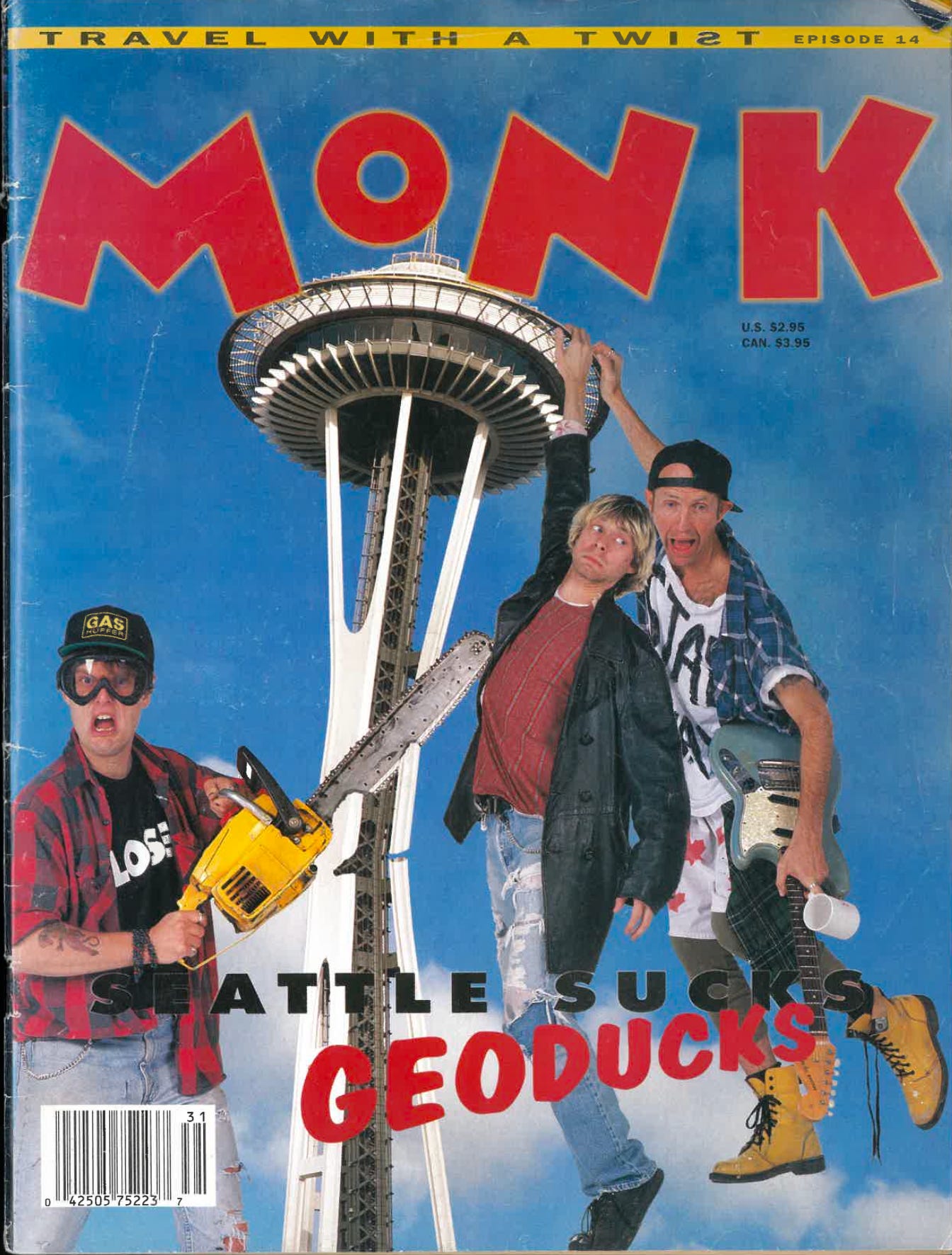
Monk was a very idiosyncratic travel magazine entirely (?) written by Jim Crotty and Michael Lane, a.k.a. the Monks. They met in San Francisco in the mid-1980s, “fell in love” (issue #11), and quickly realized they were kindred spirits who yearned to stay on the road forever. Their friends called them the Monks because of their spartan lifestyles and interest in meditation. Monk started off in the mid-eighties as a newsletter documenting their road trips, eventually evolving into a full-color magazine replete with custom Absolut ads. In their own words (issue #13):
Monk is the story of two grown men who quit their jobs and sold everything they owned and hit the road with their cats, Nurse and Nurse’s Aide, and for six years, three months and 12 days argued across America publishing the world’s only mobile magazine, traveling first in a ‘72 Ford Econoline van and then in a 26-foot Fleetwood Bounder motorhome, reporting on the incredible people, places, and phone booths they encountered along the way, until they drove each other crazy living in such a tight space together, especially when they arrived in New York, where three burglaries wiped them clean and the motorhome stopped running and Michael turned 40 and Jim started chasing women and things seemed so dim until one day Mike fled to Florida, bought a bikini, found Jim with a mermaid, as a brilliant laser beam came streaming out of Disney World beckoning The Monks to pick themselves up by the bootstraps and get back on the road and just trust that by spreading a message of peace, love and goofiness sprinkled with ample doses of safe sex, water ballet and political correctness, all their needs would be taken care of right down to their very next carton of soy milk…So, the journey continues."
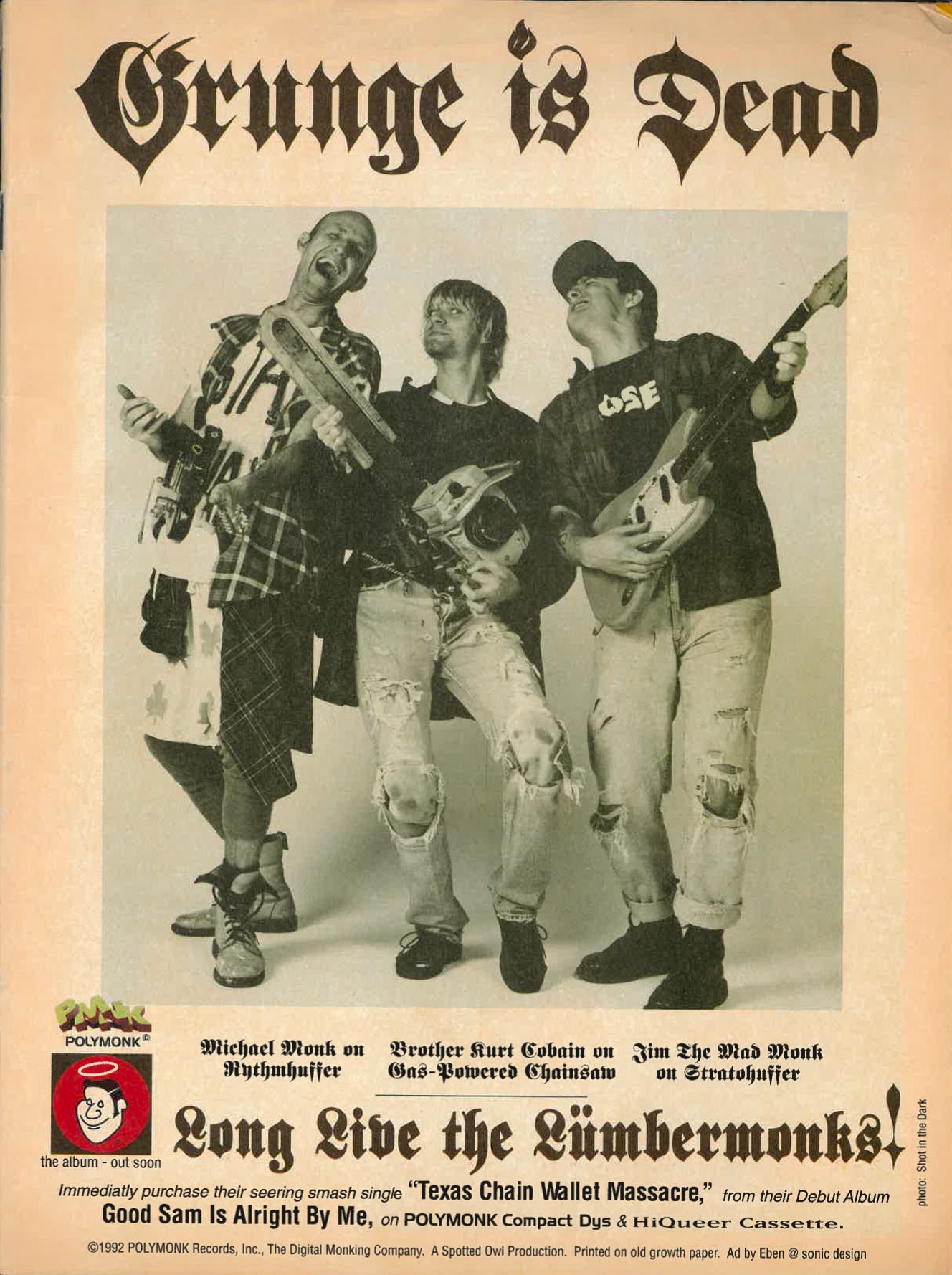
They did the whole magazine on an Mac in their RV, negotiating ad buys on payphones. As Crotty told the New York Times in 1991, “We like to say we’re Charles Kuralt meets Jack Kerouac with a little Laurel and Hardy thrown in.” They seemed to show up places with only the haziest of expectations. The Seattle issue—they called them “episodes”—is notable for featuring a lot of Kurt Cobain good-naturedly playing along with the Monks. Instead of their usual opening letter, for example, there’s this fake ad:
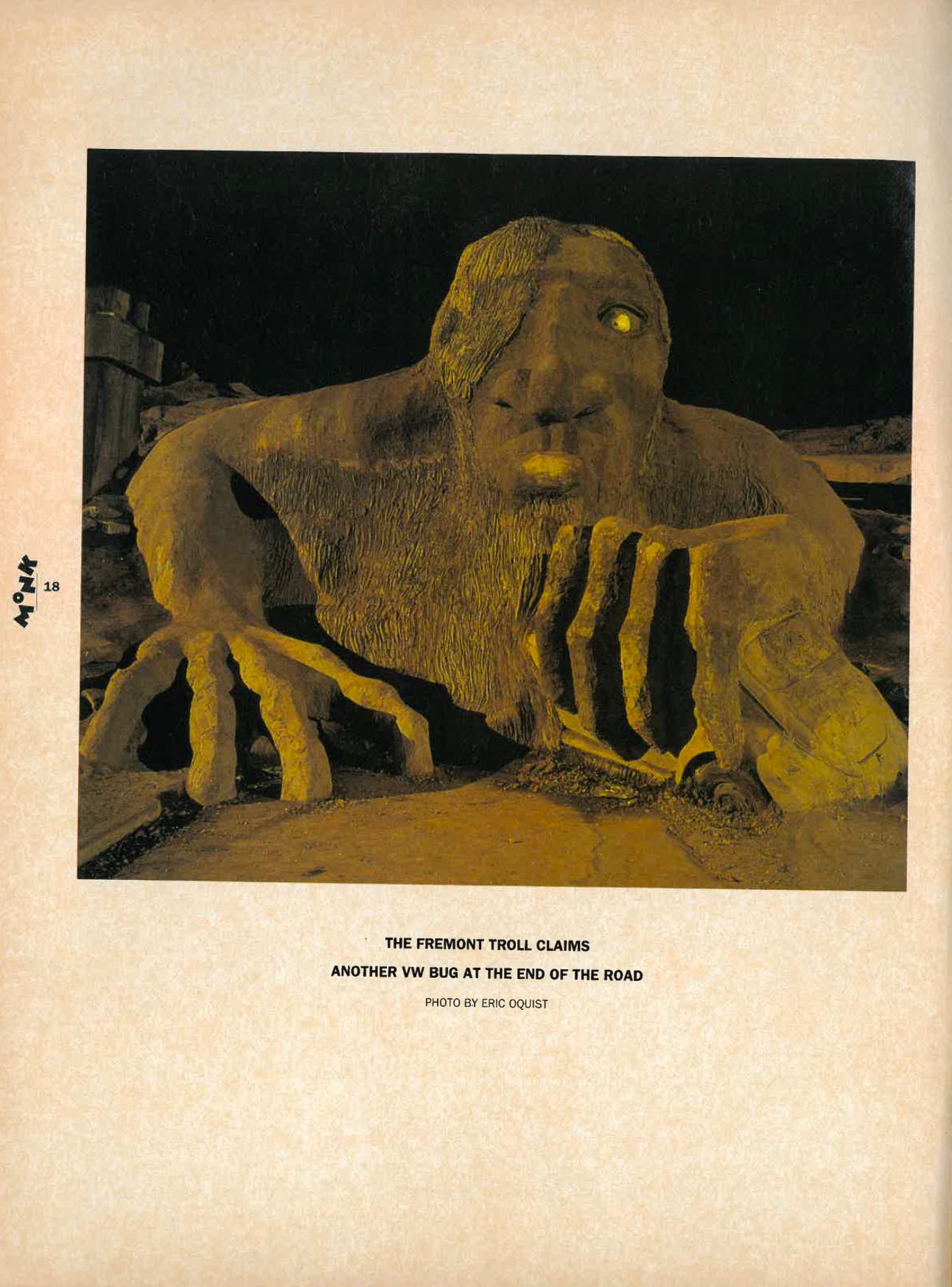
The Monks loved Seattle. “You can walk freely in almost all areas at all hours without fearing for your life,” they write. “The homeless are unobtrusive. You never get depressed by the weather because there’s so many drugs available. There’s always something great to do, but not so much that you feel overwhelmed. And it’s the only place in the world where you can write a check for a cup of coffee and ask for change.” This is a place of “friendship and wet shoes and weird funky art and cheap eats and painted cars and not enough sex” capable of producing people like Gary Larson and Lynda Barry and resilient enough to resist the “Johnny Come Longhairs” and opportunists arriving circa 1992.
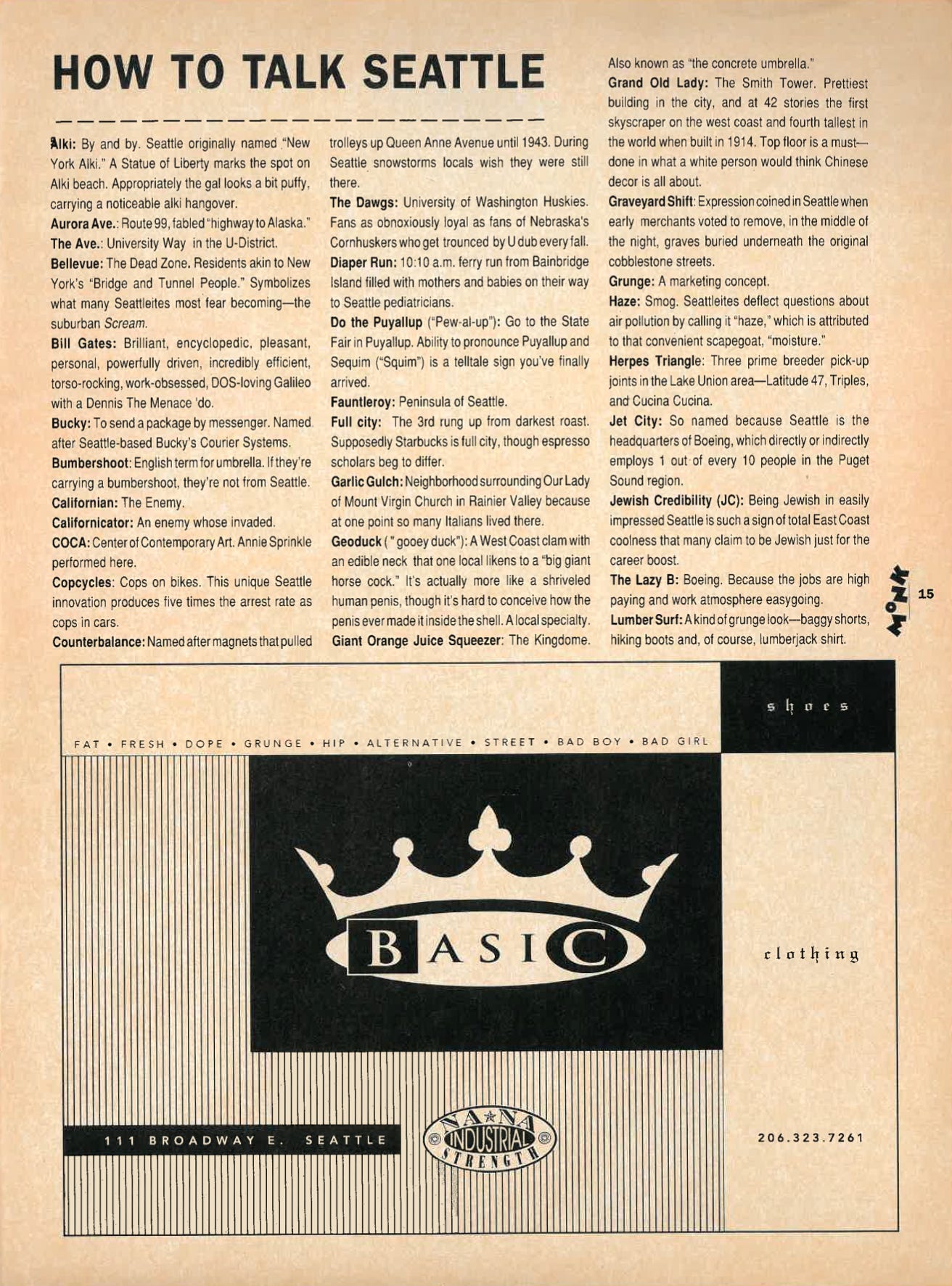
As usual, they offer a guide to the local lexicon:
Monk basically feels like a long, weird novel about postmodern America serialized as a run of magazines. At this point in the story, their RV has been left behind for repairs at a garage in the Ozarks (the subject of issue #8). They arrive in Seattle by plane before seeking out the “scuzziest” rental car they can find.
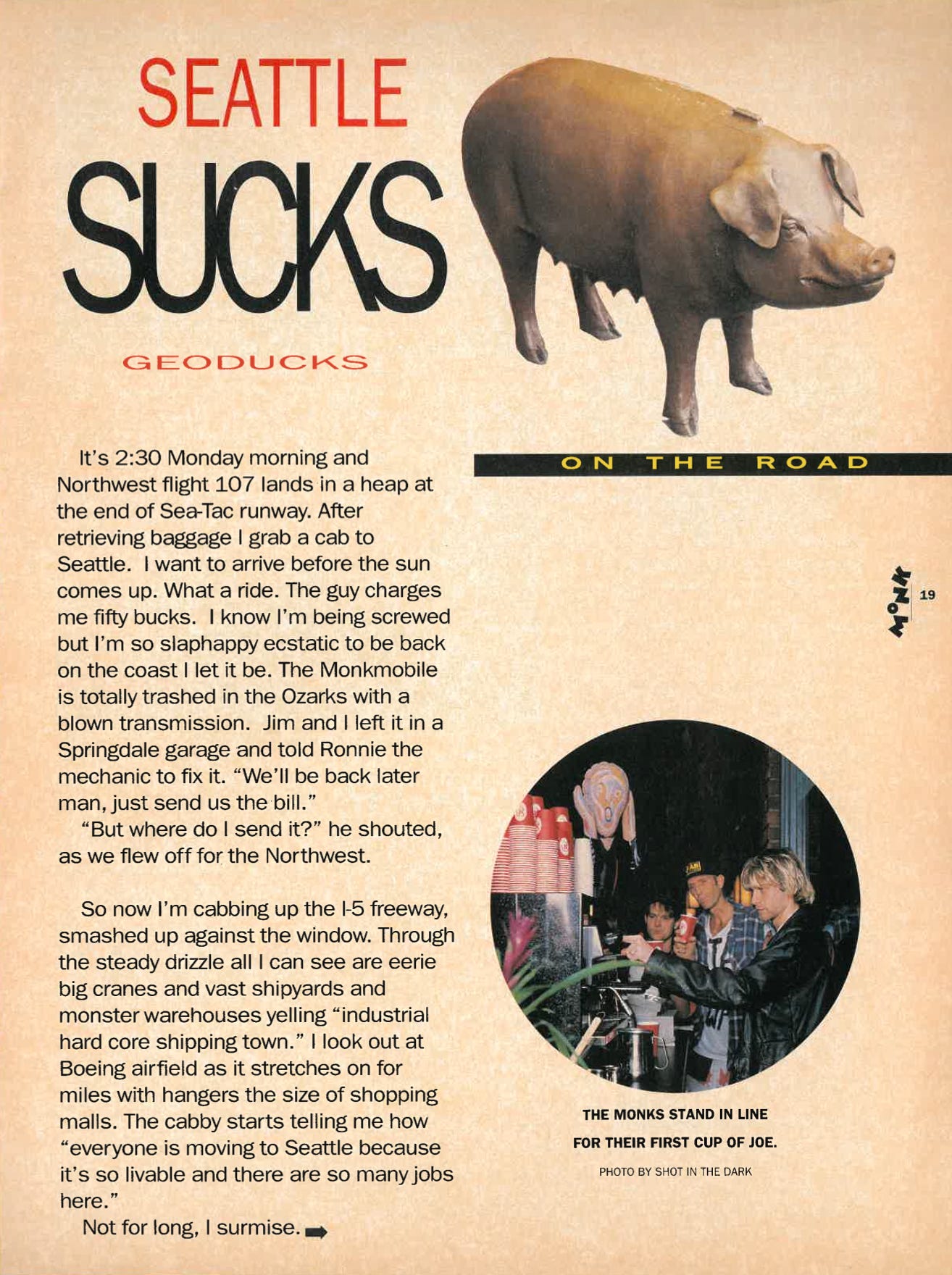
Only published photo of Kurt Cobain working an espresso machine? Likely.
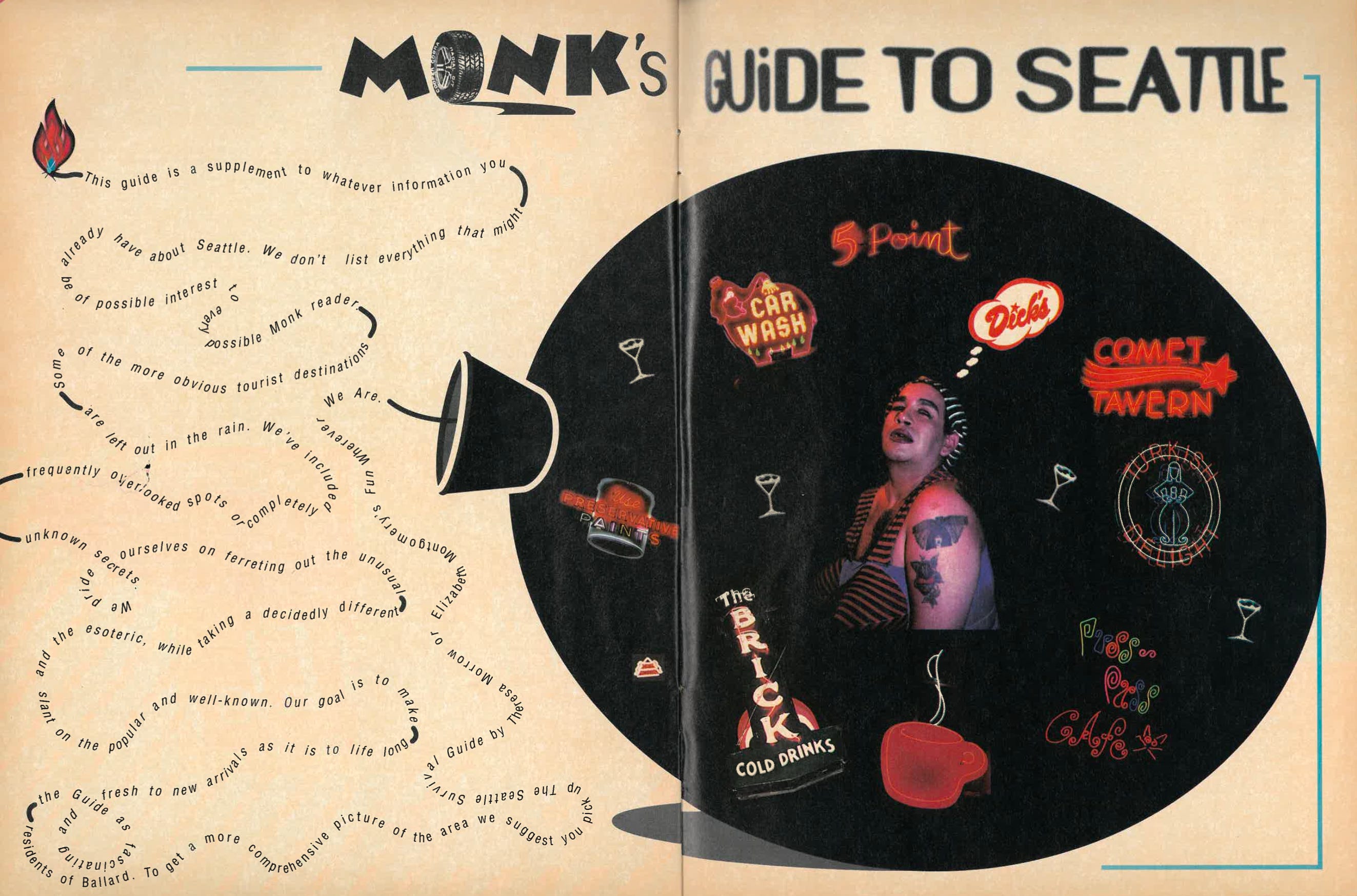
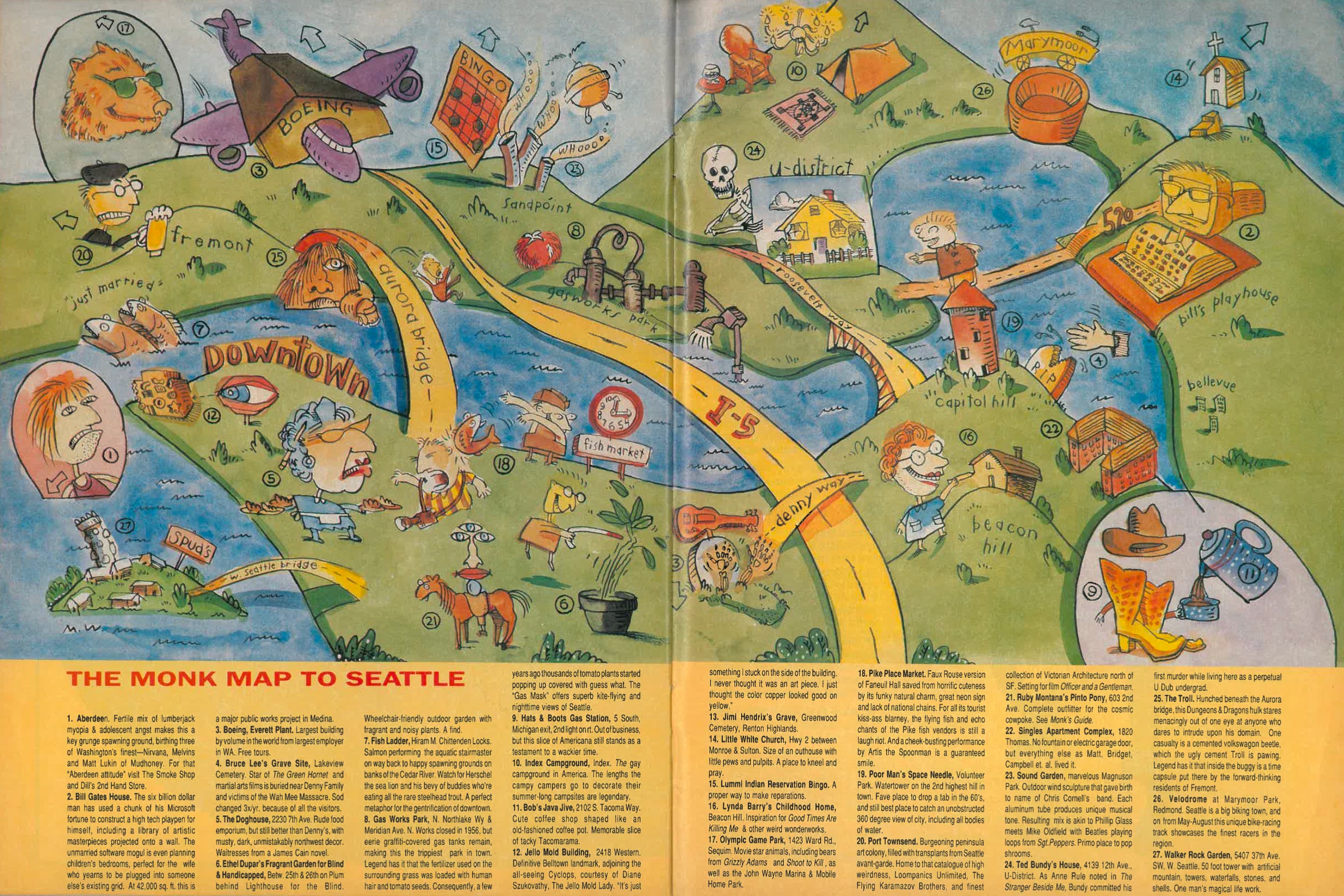
The Monks visit dive bars and locally-famous coffee shops. They buy a geoduck for no apparent reason and learn how to properly order a latte. (“Coffee culture” was still vaguely avant-garde in 1992.) They see that nobody in Seattle carries an umbrella. They visit the Hat Lady of Ballard and learn that the sod at Bruce Lee’s gravesite is changed three times a year because of all the visitors. They comb the club listings to figure out Seattle’s best band names (Windham Hell is very good) and talk to locals about their changing city (Charles Peterson: “I wish I had a dollar for every backward baseball cap I see.”) They talked to as many people as they possibly could, including a local comedian whose bit is sciencey stuff…
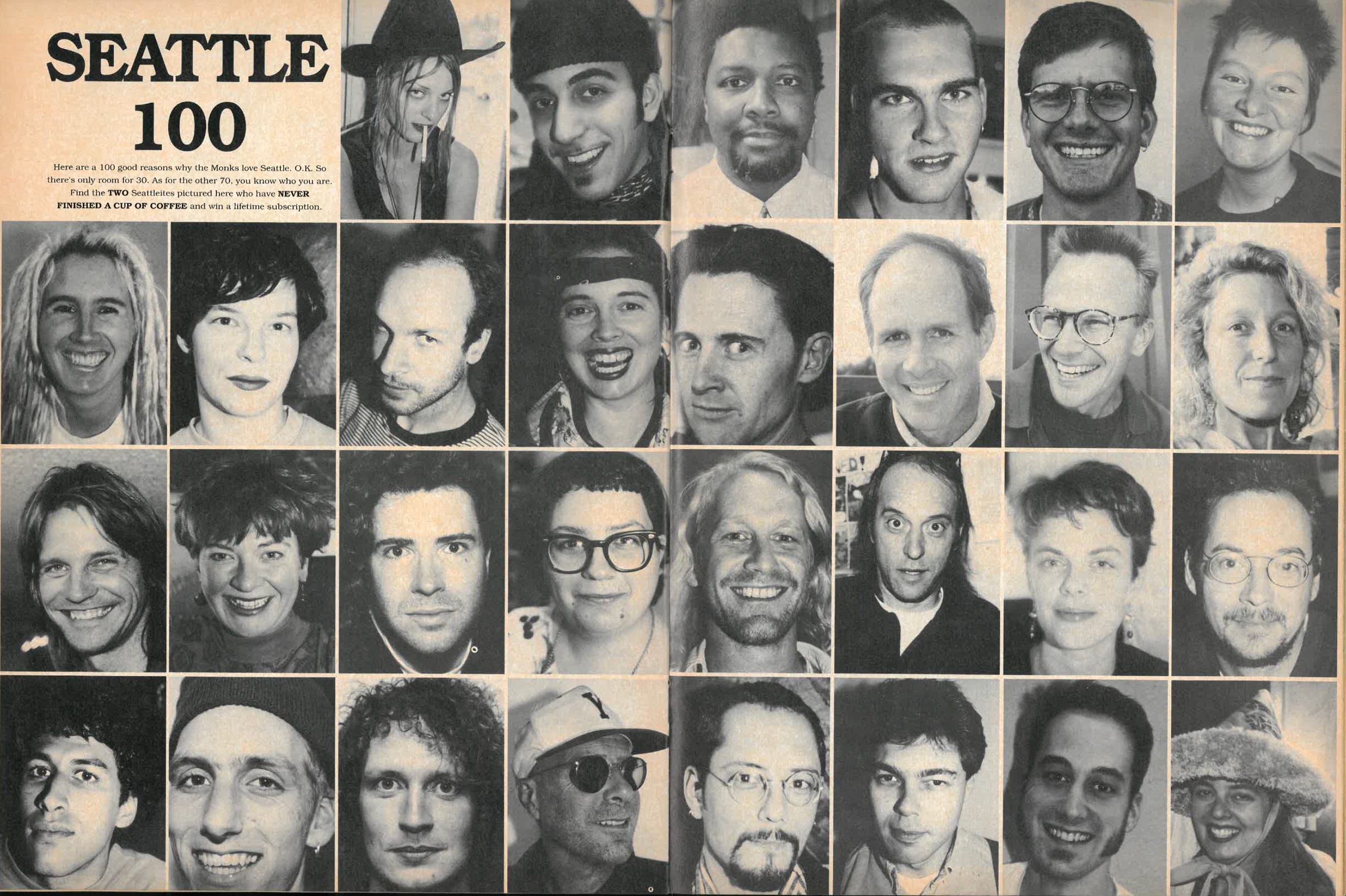
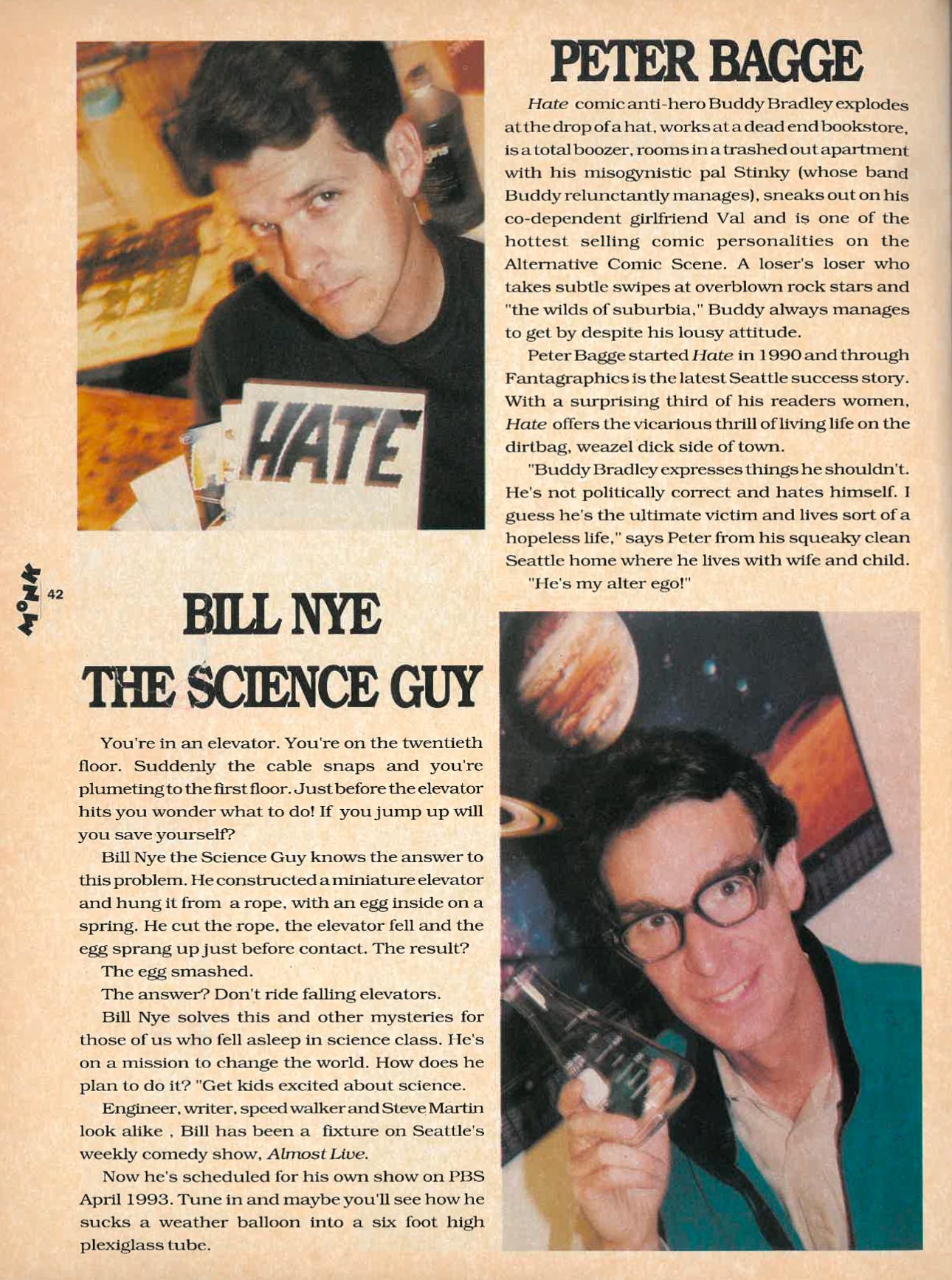
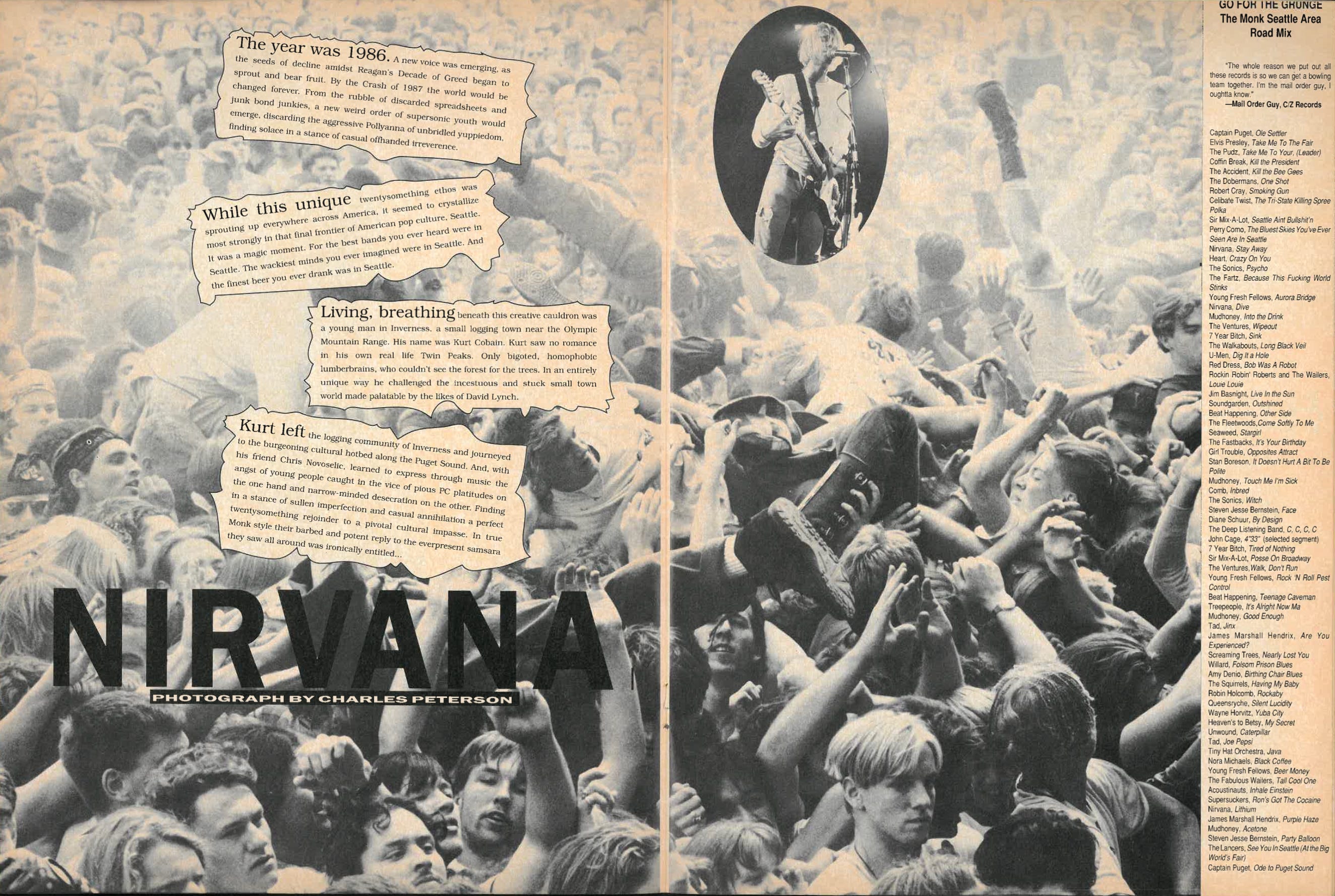
Of course, the most notable people they speak with are Kurt, Chris, and Dave from Nirvana. This would be around the time Incesticide came out. Chris talks about how he’s not actually a slacker (“I’ve always been motivated. Established dialogues. Voted.”) and Dave reminisces about his early days living with Cobain—“Kurt and I didn’t know each other. We’d sit in this apartment, no TV, no radio, nothing, no noise, for hours on end, sitting there completely silent.” He wisely observes that he is “here to balance out everyone’s insanity.”
The Cobain interview isn’t up there with the famed 1993 Advocate one, though he makes the same point about probably being bi. It focuses largely on his childhood in Aberdeen and how he got run out of town after dropping acid and spray-painting “queer” on the side of “the local rednecks’ trucks.” They chase after him, yelling, “There’s the queer vandal!”
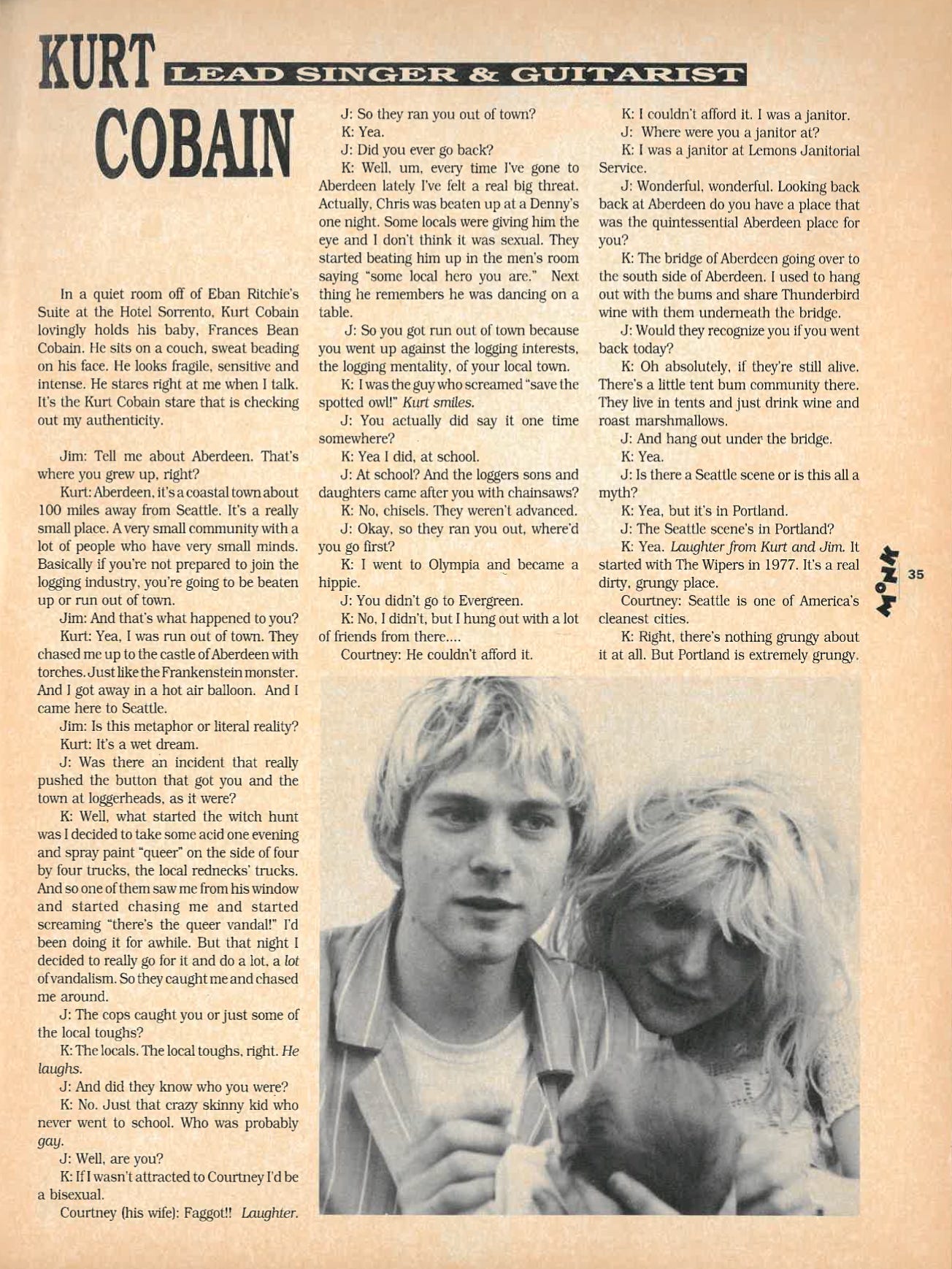
Given how overburdened Nirvana was at this time, it’s nice how bemused and silly Cobain is with the Monks. He conducted the interview while cradling his his baby, and with Courtney Love by his side.
Monk: Is there a Seattle scene or is this all a myth?
Kurt: Yea, but it’s in Portland.
M: The Seattle scene’s in Portland?
K: Yes. It started with the Wipers in 1977. It’s a real dirty, grungy place.
Courtney: Seattle is one of America’s cleanest cities.
K: Right, there’s nothing grungy about it at all. But Portland is extremely grungy.
They end with Cobain abdicating his crown as “representative of the youth of America” to Eddie Vedder of Pearl Jam. “He stole my look,” Cobain jokes, “and he uses it better than I.”
There were travel guides in the eighties and nineties, but most of them catered to a more aspirational kind of tourism, not the punk couch-surfing or regional freaks of Monk. I followed so many D.I.Y publications in the nineties that were about imagining how great life was somewhere else—it's inspiring to read about two dudes who just went for it themselves. It was a very odd niche. “Being on the road you have to open up to all people. There’re a lot of people traveling like us in vans but they would never these chance encounters because they will just stick to certain tourist centers,” they told the LA Times. “We represent a new kind of spiritual nomad who is not bound by religious norms.” While they sought out the same kinds of experiences/back alleys/nodes on their trips, each city feels so distinct, so full of local character/s and idiosyncratic crises—it’s a far cry from how generic urban cultures have become in the age of IG/AirBNB.
(Tangent: did you know the great writer Joy Williams also published a wonderful insider’s travel guide to the Florida Keys?)
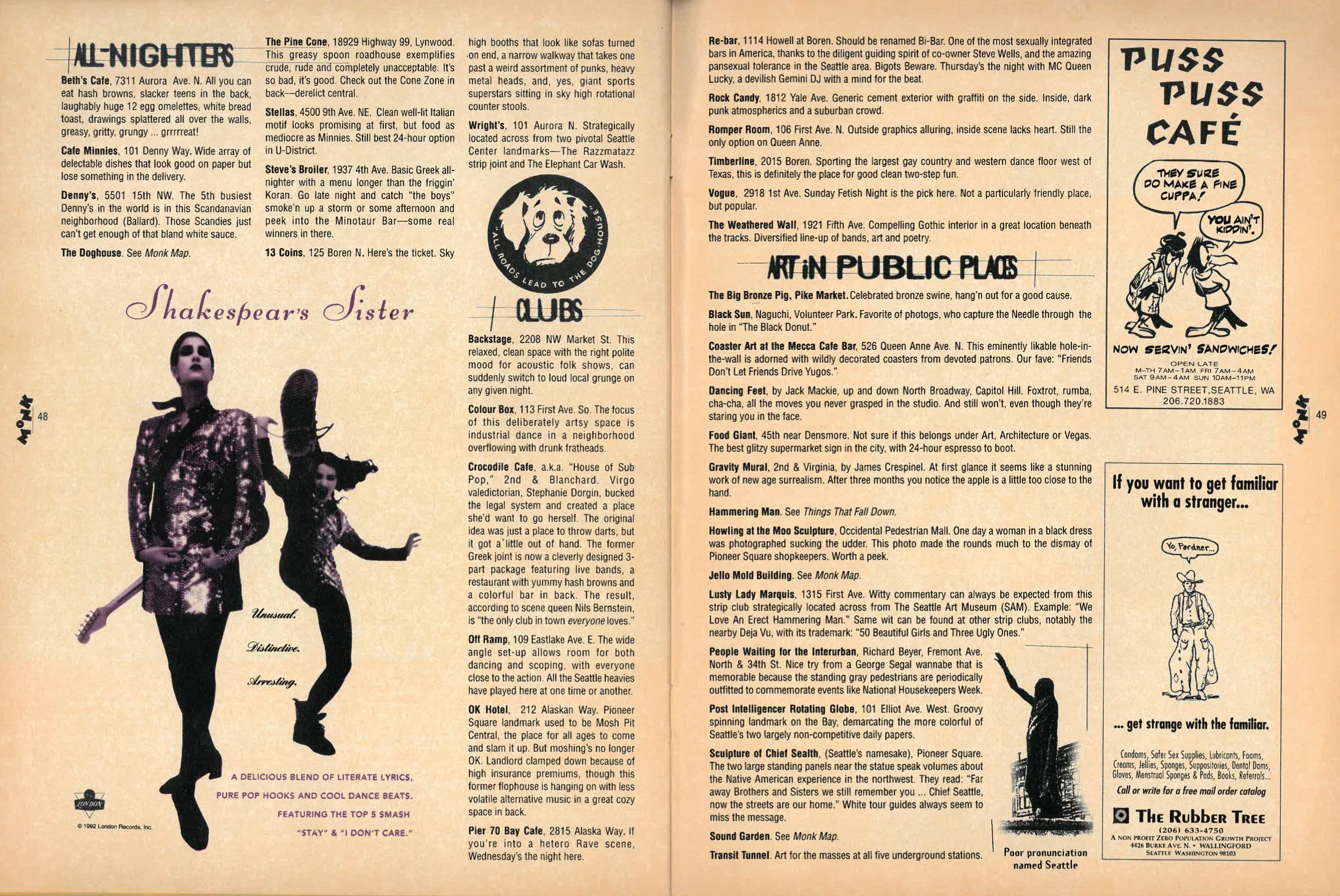
The 1991 Times story about Monk nods at the “hundreds of homemade publications” springing up at the time. It’s a fascinating story from a 2026 vantage, as the Monks ponder what it means to be a “professional” magazine while still guarding the purist ideals that first set them on their adventures. They didn’t get into this to make money, Crotty explains. “We did it to travel.” They were able to do so by securing a ton of ads, but even those are split between Absolut Vodka and incredibly niche ones for healing crystals, bars and local businesses, cassettes about subliminal messaging.
Network Q was a monthly, subscription-based VHS magazine in the nineties devoted to LGBTQ stories. Here’s a charming profile they did of the Monks as they run around Los Angeles. They look for eccentric houses, try to meet with their agent at CAA(!), shop for Korean food (still an oddity for white people circa back then), and discuss their sex life:
We basically live in an awful version of Monk everyday online, where all meaningfully out-of-the-way stuff is just fodder for influencers, rather than a tiny piece of some larger story someone is trying to tell about America. I realize I sound 300 years old saying this, but it’s why I prefer Diners, Drive-Ins and Dives to IG. I just think it’s useful to think about how the same impulses that once drove some dudes in the 1980s still drive people today, only there’s a lot more money at stake. For one, the cost of bumming around these cities is a lot higher. And the possibility of living for content, rather than keeping experiences “pure” (whatever that means) or contextualized, promises too great a financial return. The Monks communicated in their own language, worshipping their own totems of kitsch/the vernacular, but they were the opposite of gatekeepers. As Crotty explained to Network Q, Monk was all about “not finding what you’re looking for…and finding what’s looking for you.”
Monk lived on until around 2000. I discovered it many years later at a thrift shop while waiting for my car to get fixed at a garage in Ridgewood. Such is my sickness that I still remember the other magazines I found that day. The last issue of Monk was the only city they covered twice (New York) and features the Twin Towers on the cover. While doing some light googling I learned that Crotty also worked as a political speechwriter and a high school debate coach in the South Bronx (he even made a film about one of this teams).
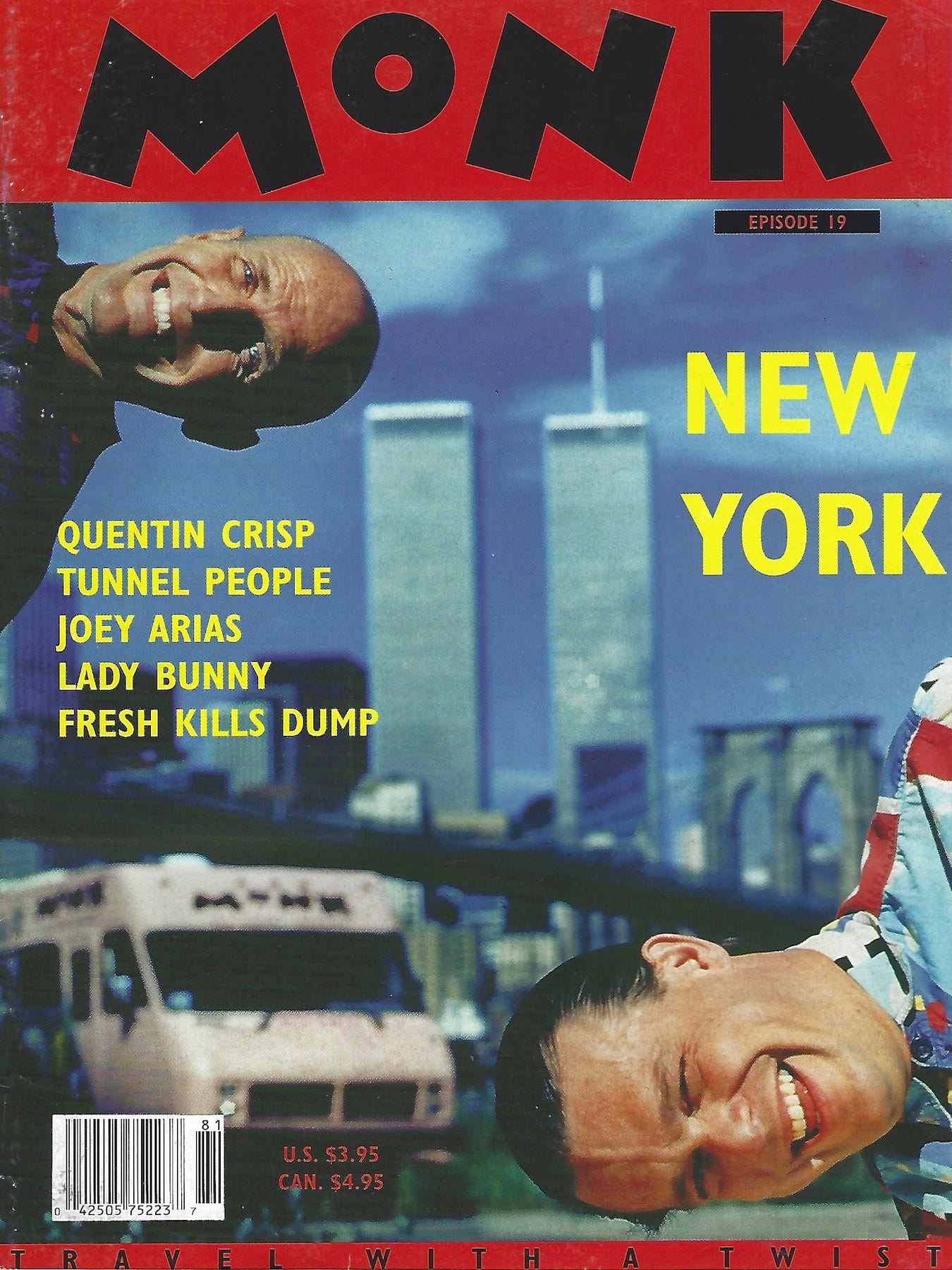
I also saw that Monk maintains a website where you can order many back issues for $4.95 and the Seattle one for $25,000. I like the San Francisco issue a lot—it’s really a time capsule of a much scuzzier and desperate time, and a reminder that there was once an SF band called JFKFC. They’re all worth reading, and they’re more rewarding when read together. When I see them at the Rathskeller in Boston or read about their misadventures with Vaginal Creme Davis in Los Angeles, I don’t really feel envious or nostalgic. Places change, donut shops become banks, neighborhood weirdos eventually start contributing to a 401k. And then a whole new world replaces them. I’d like to imagine there are still people doing Monk-like stuff for love of wanderlust, drawing up alternate maps of the world, finding their own, bizarre little haunts, only I just haven’t found them yet. Maybe it hasn’t found me, and it’s not supposed to.
Love this. I remember Monk well. Given the spirit of the times, they seemed to be living the dream. Some friends started an online travel magazine similar to Monk that documented their road trips, and it wound up being reviewed in The Web Magazine—yes, there was a print magazine that reviewed websites, and The Web also apparently founded the Webbys.
This is my first contact with your substack, what a delight. I also love magazines more than most humans, with special interests in textiles (weaving, sewing, knitting). I especially love how they can feel like handheld time machines -- the ads especially give a peek at the whole context